Functions and Scope
In Machine Learning, we often repeat complex logic—calculating the distance between points, normalizing features, or computing gradients. Functions allow us to package this logic into reusable blocks, reducing errors and making our code "DRY" (Don't Repeat Yourself).
1. Anatomy of a Function
A function takes an input (parameters), performs an action, and returns an output.
def calculate_mse(y_true, y_pred):
    """Calculates Mean Squared Error."""
    error = (y_true - y_pred) ** 2
    return error.mean()
2. Arguments and Parameters
Python offers flexible ways to pass data into functions, which is essential for managing dozens of hyperparameters.
A. Positional vs. Keyword Arguments
- Positional: Order matters.
- Keyword: Explicitly naming parameters (safer and more readable).
def train_model(learning_rate, epochs):
    print(f"LR: {learning_rate}, Epochs: {epochs}")

# Keyword arguments are preferred in ML for clarity
train_model(epochs=100, learning_rate=0.001)
B. Default Values
Useful for hyperparameters that have a standard "sane" default.
def initialize_weights(size, distribution="normal"):
    # If distribution isn't provided, it defaults to "normal"
    pass
3. Lambda Functions (Anonymous Functions)
For simple, one-line operations, Python uses Lambda functions. These are frequently used in data cleaning with pandas.
# Convert Celsius to Fahrenheit for a feature
c_to_f = lambda c: (c * 9/5) + 32
print(c_to_f(0)) # 32.0
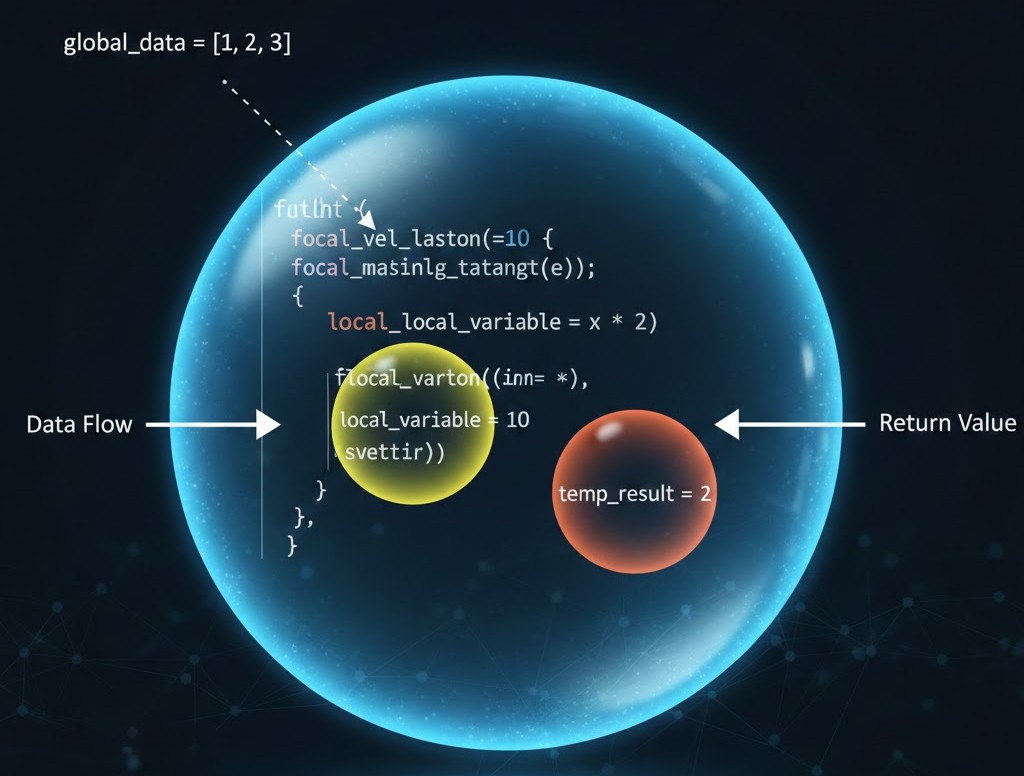
4. Understanding Scope
Scope determines where a variable can be seen or accessed.
- Global Scope: Variables available throughout the entire script (e.g., a dataset loaded at the top).
- Local Scope: Variables created inside a function (e.g., a temporary calculation). They "die" once the function finishes.
5. Args and Kwargs (*args, **kwargs)
In advanced ML libraries (like Scikit-Learn), you'll see these used to pass a variable number of arguments.
*args: Passes a list of positional arguments.**kwargs: Passes a dictionary of keyword arguments.
def build_layer(**hyperparams):
    for key, value in hyperparams.items():
        print(f"{key}: {value}")

build_layer(units=64, activation="relu", dropout=0.2)
6. Functions as First-Class Citizens
In Python, you can pass a function as an argument to another function. This is how we pass different activation functions or optimizers into a training function.
def apply_activation(value, func):
    return func(value)

# Passing the 'relu' function as data
output = apply_activation(10, relu)
Functions help us stay organized, but sometimes code fails due to unexpected data or math errors. We need a way to catch those errors without crashing our entire training pipeline.