PMF vs. PDF
To work with data in Machine Learning, we need a mathematical way to describe how likely different values are to occur. Depending on whether our data is Discrete (countable) or Continuous (measurable), we use either a PMF or a PDF.
1. Probability Mass Function (PMF)
The PMF is used for discrete random variables. It gives the probability that a discrete random variable is exactly equal to some value.
Key Mathematical Properties:
- Direct Probability: . The "height" of the bar is the actual probability.
- Summation: All individual probabilities must sum to 1.
- Range: .
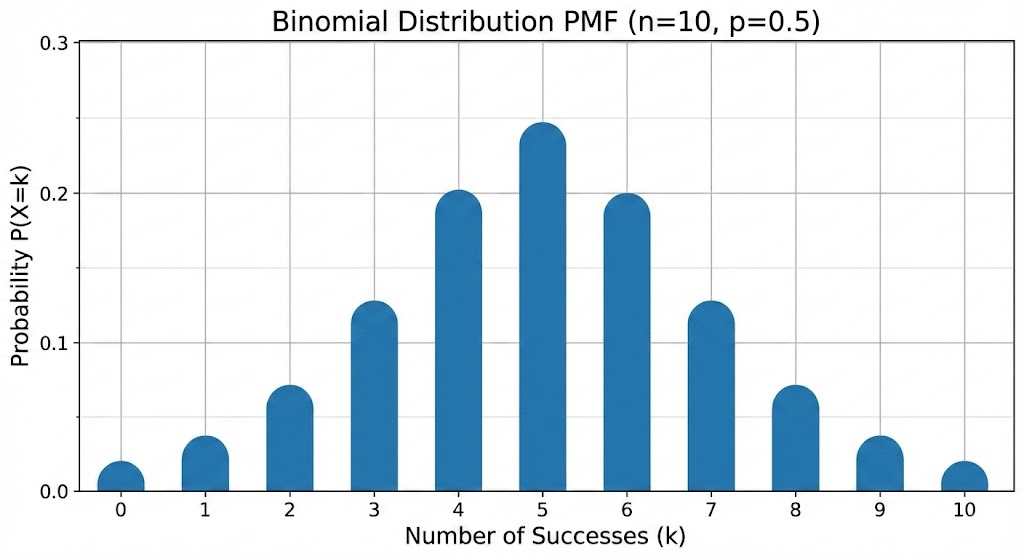
Example: If you roll a fair die, the PMF is for each value . There is no "1.5" or "2.7"; the probability exists only at specific points.
2. Probability Density Function (PDF)
The PDF is used for continuous random variables. Unlike the PMF, the "height" of a PDF curve does not represent probability; it represents density.
The "Zero Probability" Paradox
In a continuous world (like height or time), the probability of a variable being exactly a specific number (e.g., exactly cm) is effectively 0.
Instead, we find the probability over an interval by calculating the area under the curve.
Key Mathematical Properties:
- Area is Probability: The probability that falls between and is the integral of the PDF:
- Total Area: The total area under the entire curve must equal 1.
- Density vs. Probability: can be greater than 1, as long as the total area remains 1.
3. Comparison at a Glance
| Feature | PMF (Discrete) | PDF (Continuous) |
|---|---|---|
| Variable Type | Countable (Integers) | Measurable (Real Numbers) |
| Probability at a point | ||
| Probability over range | Sum of heights | Area under the curve (Integral) |
| Visualization | Bar chart / Stem plot | Smooth curve |
4. The Bridge: Cumulative Distribution Function (CDF)
The CDF is the "running total" of probability. It tells you the probability that a variable is less than or equal to .
- For PMF: It is a step function (it jumps at every discrete value).
- For PDF: It is a smooth S-shaped curve.
5. Why this matters in Machine Learning
- Likelihood Functions: When training models (like Logistic Regression), we maximize the Likelihood. For discrete labels, this uses the PMF; for continuous targets, it uses the PDF.
- Anomaly Detection: We often flag a data point as an outlier if its PDF value (density) is below a certain threshold.
- Generative Models: VAEs and GANs attempt to learn the underlying PDF of a dataset so they can sample new points from high-density regions (creating realistic images or text).
Now that you understand how we describe probability at a point or over an area, it's time to meet the most important distribution in all of data science.