Recall: The Sensitivity Metric
Recall, also known as Sensitivity or True Positive Rate (TPR), measures the model's ability to find all the positive samples in a dataset. It answers the question: "Of all the actual positive cases that exist, how many did the model correctly identify?"
1. The Mathematical Formula
Recall is calculated by dividing the number of correctly predicted positive results by the total number of actual positives (those we caught + those we missed).
Where:
- TP (True Positives): Correctly predicted positive samples.
- FN (False Negatives): The "Misses"—cases that were actually positive, but the model incorrectly labeled them as negative.
2. When Recall is the Top Priority
You should prioritize Recall when the cost of a False Negative is extremely high. In these scenarios, it is better to have a few "false alarms" than to miss a single positive case.
Real-World Example: Cancer Detection
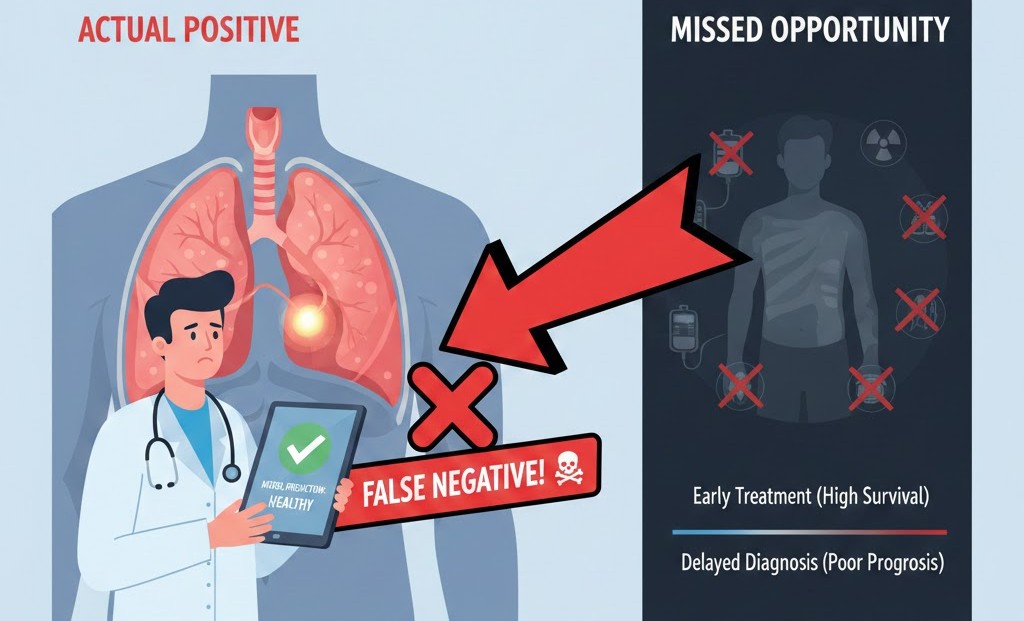
- Positive Class: Patient has cancer.
- False Negative: The patient has cancer, but the model says they are "Healthy."
- The Consequence: The patient does not receive treatment, which could be fatal.
- The Goal: We want 100% Recall. We would rather tell a healthy person they need more tests (False Positive) than tell a sick person they are fine (False Negative).
3. The Precision-Recall Inverse Relationship
As you saw in the Precision module, there is an inherent trade-off.
- To increase Recall: You can make your model "less strict." If a bank flags every transaction as potentially fraudulent, it will have 100% Recall (it caught every thief), but its Precision will be terrible (it blocked every honest customer too).
- To increase Precision: You make the model "more strict," which inevitably leads to missing some positive cases, thereby lowering Recall.
4. Implementation with Scikit-Learn
from sklearn.metrics import recall_score

# Actual target values (1 = Sick, 0 = Healthy)
y_true = [1, 1, 1, 0, 1, 0, 1]

# Model predictions
y_pred = [1, 0, 1, 0, 1, 0, 0]

# Calculate Recall
score = recall_score(y_true, y_pred)

print(f"Recall Score: {score:.2f}")
# Output: Recall Score: 0.60
# (We found 3 out of 5 sick people; we missed 2)
5. Summary Table: Precision vs. Recall
| Metric | Focus | Goal | Failure Mode |
|---|---|---|---|
| Precision | Quality | "Don't cry wolf." | High Precision misses many real cases. |
| Recall | Quantity | "Leave no one behind." | High Recall creates many false alarms. |
6. How to Balance Both?
If you need a single number that accounts for both the "False Alarms" of Precision and the "Misses" of Recall, you need the F1-Score.
References
- Google Machine Learning Crash Course: Recall Metric
- Wikipedia: Sensitivity and Specificity
Is your model struggling to choose between Precision and Recall? Let's look at the "middle ground" metric.